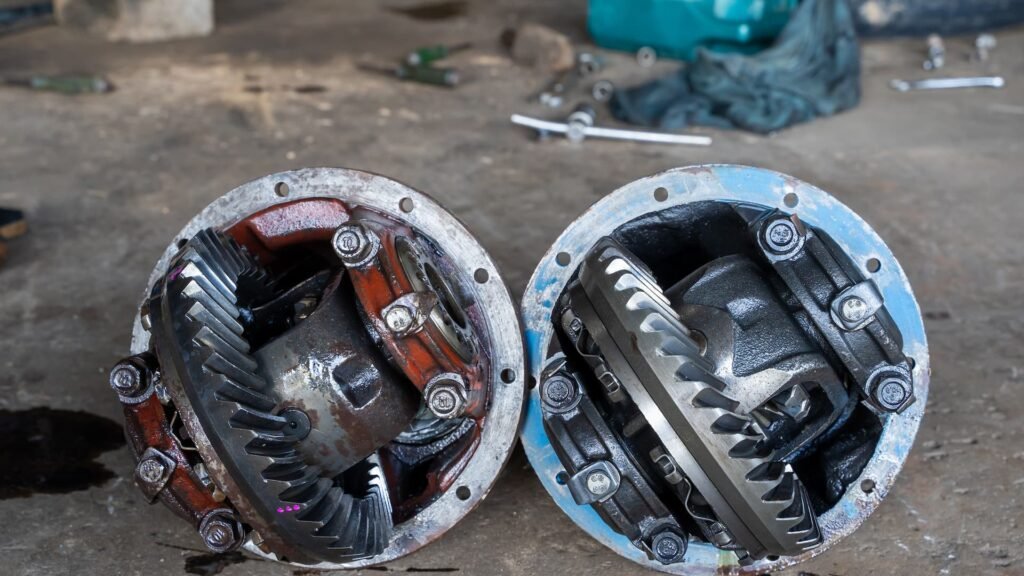
That low whine, howl, or growl from the back of your vehicle can ruin a drive fast. It might start subtle—a rhythmic humming that grows louder with speed—then escalate to clunking on acceleration/deceleration, vibrations through the floor, grinding noises during turns, or even a burning smell if things overheat. Other signs include oil leaks from the differential cover, uneven tire wear, the vehicle pulling to one side under load, or strange handling when cornering. These point to a failing rear differential (often part of the complete rear axle assembly)—worn bearings, damaged ring and pinion gears, low/contaminated fluid, or internal wear from towing heavy loads or off-road use.
The rear differential splits torque between the rear wheels and allows them to rotate at different speeds during turns. When it fails, you risk locked gears, broken axles, or a complete breakdown. Replacing it new is pricey: full rear differential or axle assembly replacements average $2,500–$6,000 including labor, with some quotes hitting $3,000–$7,000+ depending on the vehicle (higher for trucks like F-150s, Silverados, Rams, or 4×4 SUVs). Remanufactured units (rebuilt with new bearings/gears) often fall in the $1,500–$4,000 range for the part alone, plus $500–$1,500 shop labor for setup (pinion depth, backlash, preload adjustments) and fluid fill.
That’s where opting for a used rear differential (or complete rear axle) from salvage sources becomes a game-changer. These are genuine OEM assemblies pulled from low-mileage wrecked vehicles—typically front-end or side collisions where the rear end remained intact and unstressed. Reputable online platforms pull from nationwide junkyard networks, offering tested units with gear tooth inspections, bearing checks, no housing cracks, clean fluid (no metal shavings), and smooth spin tests. Donor mileage is usually listed (aim for under 100k), along with photos, gear ratio details (e.g., 3.55, 3.73, 4.10), diff type (open, limited-slip, locking), and compatibility notes for brakes/suspension/ABS.
Used rear differentials typically cost $400–$1,500 shipped—often 50–80% less than reman/new—with many including 30-day warranties or longer. For popular trucks/SUVs, prices stay on the lower end; rarer setups or heavy-duty applications might push higher but still save thousands.
A typical case: A pickup owner notices whining and vibrations after towing—shop quotes $4,800 reman installed. Online search finds a used rear axle assembly from a 60k-mile donor (minor wreck, rear untouched) for $950 shipped with warranty. Local shop installs for $900—total around $1,850. Truck runs quiet and strong afterward, no pulls or leaks.
Why Used Rear Differentials (and Broader Used Car Parts Online) Make Sense
Salvage-sourced used parts get real scrutiny: visual/mechanical checks, fluid analysis, and operational tests ensure they’re not junk. Benefits include:
- Big savings — Thousands less than new/reman, especially for trucks/SUVs where diffs are beefy and expensive.
- OEM quality — Factory-matched gears, ratios, and housings—no aftermarket mismatches.
- Availability — Easier for discontinued models or specific ratios than dealer stock.
- Warranties — Coverage and returns minimize risk.
- Eco perks — Reusing heavy castings cuts manufacturing emissions and waste.
This approach extends to used car parts online for anything else failing: alternators, transmissions, engines, AC compressors, control arms, radiators, or body panels. Online platforms make it effortless—search by VIN/make/model/year for exact fits, compare listings from multiple yards, see donor details/photos/tests, and get fast shipping (often free/low-cost). No need to hunt local yards in the rain or hope they have your part.
How to Buy and Install a Used Rear Differential Smartly
- VIN first — Ensures gear ratio, spline count, axle width, brake type (disc/drum), and diff style match.
- Prioritize details — Low-mile donor, “tested,” clear photos (gears/housing/fluid), no damage.
- Warranty/returns — 30+ days free; test immediately (spin outputs, check for noise/roughness).
- Installation — Shop job: drop old axle, transfer good parts (brakes/shocks), set pinion/backlash properly, fill with correct synthetic gear oil (75W-90, LSD additive if limited-slip). Labor $500–$1,200; change fluid and inspect U-joints.
- Red flags — No photos/history, high-mileage without testing, “as-is,” or too-good-to-be-true prices.
Used rear differentials from salvage yards offer a reliable, cost-effective fix for rear-end woes. Combined with broader used car parts online shopping, you handle repairs affordably while keeping your truck, SUV, or RWD car running strong.
If that whine or clunk starts bugging you, grab your VIN and check options. A used rear differential could save big and get you back to smooth driving without the massive bill.